

Lentigines around the eyes always call for caution because of their location. The eyelid skin is among the thinnest and most sensitive on the face, so approaching it carelessly based on the pigment alone can put a burden on the surrounding skin. Today I would like to share a record of a case in which I once again faced an upper-eyelid lentigo that had kept recurring despite several treatments elsewhere.
A recurring upper-eyelid lentigo: what was its condition?
A woman in her late 30s visited the clinic with a lentigo on her right upper eyelid. The lesion had persisted for more than 10 years and had settled over a wide area, reaching about 10cm in size. She had received treatment several times at other clinics, but the pigment came back over time, and so she came to see me.
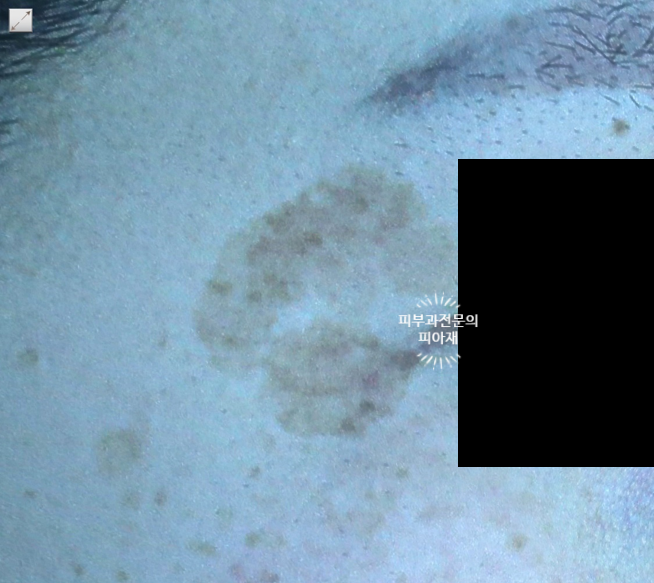
Given its location around the right eye, the treatment did not look easy. The closer an area is to the eye, the more carefully the irradiation range and intensity must be set, and how the pigment might respond during recovery also has to be taken into account.
Why does lentigo come back even after treatment?
A lentigo is a lesion involving melanocytes and pigment in the basal layer of the epidermis. Just because the visible pigment has faded does not mean the underlying background has been fully resolved, and in the clinic I often observe pigment re-emerging depending on irritation, UV exposure, and the depth of the original lesion.
So when I look at a lentigo, I check the following together.
- Whether the lesion stays in the epidermis or is entangled with the background in deeper layers
- How it was approached in previous treatments and at what point it recurred
- Whether it is a thin, sensitive area like the skin around the eyes, and therefore how the intensity should be adjusted
Pigment fading and the background being resolved are two different things. To reduce recurrence, I believe we need to look not only at the color showing on the surface but also at the conditions beneath it.
If you are curious about the histological background of this lesion, see my post on the histology of lentigo; if you want to know how lasers act on pigment, reading my post on laser principles together with the follow-up post on lasers will make it much easier to understand.
The course of this case with the Reepot laser
This patient received one session of treatment using the Reepot laser. Since it was a wide and long-standing lesion, I carefully set the irradiation intensity and range to suit its location near the eye, and then followed the course for about 5 months.
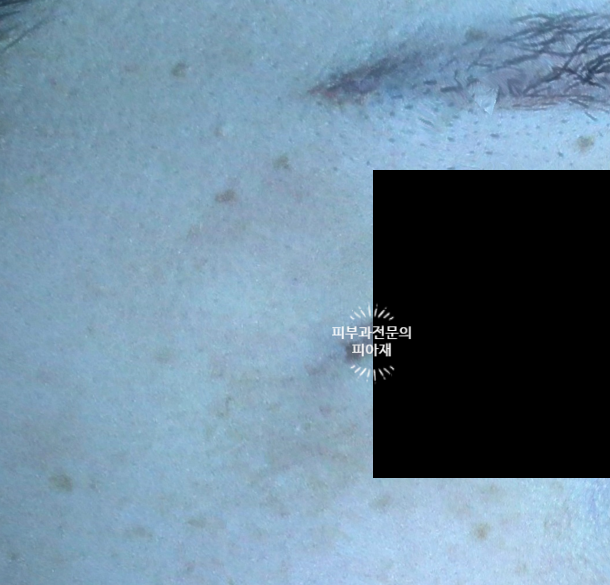
Over time, as in the photo above, we could confirm that the lentigo had faded noticeably. However, the number of treatments, recovery period, and degree of response vary with the depth of the lesion and individual skin characteristics, so I should also mention that results may differ from person to person even with the same approach.
If you have any questions, please feel free to ask through Start a chat consultation now.
Looking at before and after side by side
Comparing before and after on a single screen makes the change even clearer.
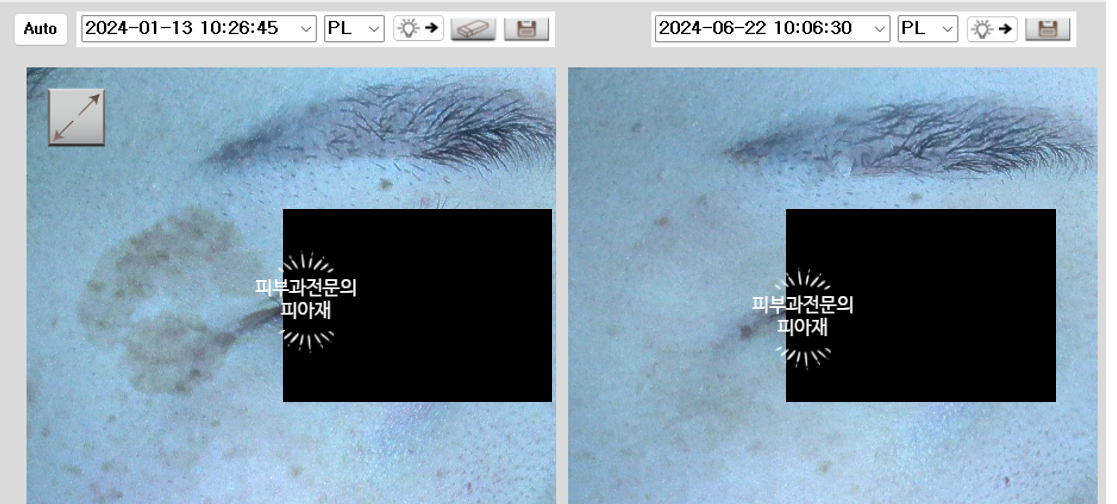
| Category | At first visit | After about 5 months |
|---|---|---|
| Lesion extent | About 10cm on the right upper eyelid | Extent noticeably reduced |
| Pigment density | Dark with distinct borders | Lighter with blurred borders |
| Treatment history | Recurred after repeated treatments at other clinics | Follow-up after one Reepot laser session |
Even a wide, long-standing eyelid lentigo like this one can be expected to improve when the plan takes its location and lesion characteristics into account. However, because recurrence is also affected by the care that follows, what comes next is just as important as the treatment itself.
Why what comes after removal matters more
After a lentigo has been lightened, sun protection and managing irritation become major variables that determine recurrence. The eye area in particular has thin skin and is prone to residual pigmentation during recovery, so it is better to set the direction of early care in advance. I have explained post-treatment recovery care in more detail in my post on the direction of recovery care after lentigo removal and my post on laser aftercare.
What I would like to say from the clinic
Eyelid lentigines are often put off because of their location, and quite a few people give up after experiencing recurrence. But if the plan is re-made considering the depth of the lesion, previous treatment history, and the characteristics of the area, the direction can change. If you have similar concerns, I recommend starting by checking the condition together while looking at photos. Costs vary depending on the condition of the lesion and are explained after a consultation.
Consult via chat
All photos used in this blog were taken and published with the patient's consent and may not be used without permission.
Author: Dr. Cho Mingyeol, Medical Director (board-certified dermatologist; Master Certification in Pigmentation, Acne, Rosacea and Hair from the Korean Dermatologists Association). You can find the full profile on the Medical Team page. First published 2024-08-06 / Last reviewed 2026-07-09
This article is intended for general information only; the appropriate treatment and outcomes may vary depending on each individual's condition.