

In consultations about stretch marks, I hear "Why do I keep getting these no matter how well I take care of my skin?" more often than "Can these be removed?" Stretch marks that appear during growth spurts or pregnancy do not harm the body in themselves, but many people come in because the red or white marks left behind bother them.
So today I would like to explain why stretch marks form and how the treatment approach differs between when they are red and after they have turned white, in the same order I explain it in the clinic.
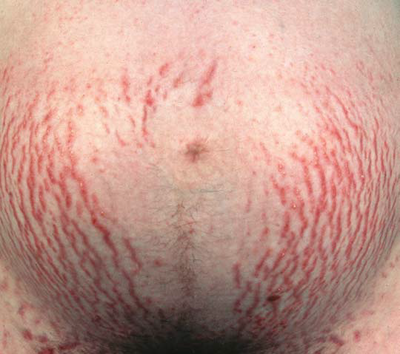
Stretch marks are traces left where the skin has stretched
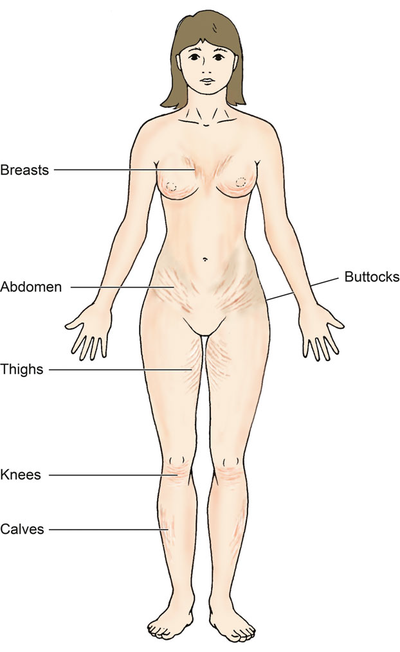
Medically, stretch marks are called Striae distensae. They can appear anywhere the skin can stretch rapidly, and where they occur differs somewhat depending on the stage of life.
- During growth spurts, they mainly appear on the buttocks, thighs, knees, calves and upper arms.
- During pregnancy, they commonly appear on the buttocks, breasts and abdomen.
In other words, rather than a specific disease, they are closer to traces left when the skin stretches faster than it can cope with and the dermis is unable to withstand that tension.
Looking at the tissue shows why the texture breaks down
To understand the direction of treatment, it helps to first look at how stretch-mark tissue differs from normal skin. In the photo below, the left is normal tissue and the right is stretch-mark tissue.
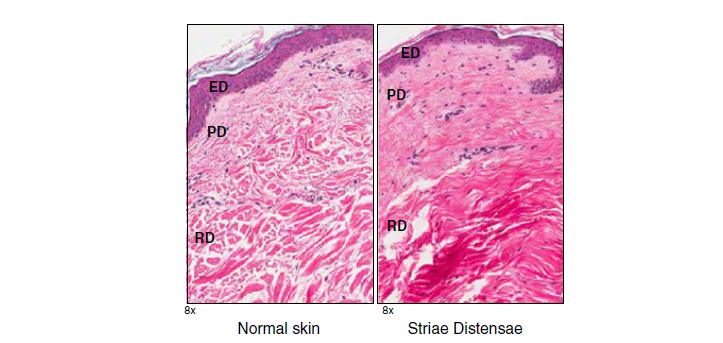
In the stretch mark, the area marked as the epidermis (ED, Epidermis) is thinner than normal and looks flatter, as if pressed down. In normal skin, collagen bundles are neatly aligned horizontally in the dermal layers, the papillary dermis (PD, Papillary dermis) and the reticular dermis (RD, Reticular dermis). In a stretch mark, by contrast, these bundles have thickened and their alignment has broken down. The distinct lines you see on the surface are the result of this collapsed collagen structure on the inside showing through.
Prevention comes first, but much of it is inborn
In principle, prevention is the most important thing. To be honest, though, there are quite a few cases where nothing can be done no matter how hard you try. The Fitzpatrick textbook, the standard reference for dermatologists, explains that ethnicity, family history and individual characteristics are more important causes than pregnancy, weight gain or BMI. In the end, it means inborn factors play a large role.
Even so, we cannot simply give up. Things you can try in daily life are to avoid rapid weight gain and to care for areas under a lot of tension (the abdomen during pregnancy) with massage.

There are so many topical products on the market that you may find it hard to choose. To tell you honestly what I think, it is not easy to treat or prevent stretch marks with cosmetics alone. Still, if I had to pick one, I think a cream containing madecassoside is a reasonable choice.
Tretinoin is meaningful when stretch marks are red
Among the topical medications prescribed in dermatology is tretinoin, a vitamin A derivative. In red stretch marks, it stimulates fibroblasts to increase the synthesis of type I collagen, which makes up the dermis, and may help to some extent in reducing changes in skin texture.
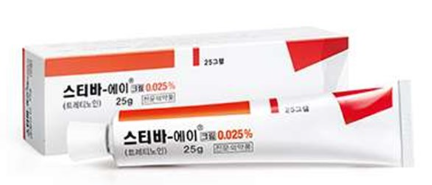
However, it must not be used during pregnancy, and since it can be irritating, it should be started at a low concentration and gradually increased. That is why I recommend using it with a prescription after discussing it with a doctor rather than judging for yourself. If you are curious about the criteria for managing red marks, the criteria I use in the clinic to decide whether red marks can be left alone is also worth reading.
Red stretch marks and white stretch marks are different stages
Over time, red stretch marks turn into white stretch marks. They are therefore broadly divided into red stretch marks (striae rubra) and white stretch marks (striae alba), and the reason for this distinction is that the treatment response and the treatment method differ.
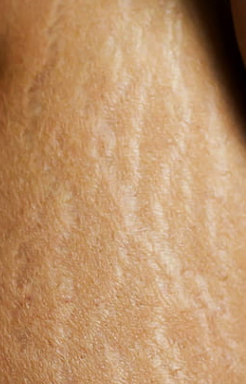
White stretch marks appear when dermal regeneration has already ended, leaving depressions along the lines where the skin tore. Put another way, they are evidence that dermal regeneration did not take place sufficiently. That is why starting treatment while redness still remains is the way to minimize how much they harden into white stretch marks.
| Category | Red stretch marks | White stretch marks |
|---|---|---|
| State | Stage in which the dermis ruptures and scarring forms | Stage after dermal regeneration has ended, leaving depressions along the lines |
| Treatment response | Reported to respond relatively well | Tends to respond more slowly and require more sessions |
| Main approach | Reducing redness together with stimulating collagen | Approach similar to scar treatment, plus addressing hypopigmentation |
The red stretch mark stage is often regarded as the golden window for stretch mark treatment. The key is to manage them actively during this period to reduce how much white stretch marks remain. However, responses vary between individuals.
Why I suggest hurrying treatment while stretch marks are red
Red stretch marks are at a stage when the skin is still expanding, the dermis is rupturing and scars are forming. That is why active management during this period is important.
The laser mainly used is a PDL (pulsed dye laser) with a 585 or 595 nm wavelength, used for vascular lesions. Representative examples include V-Beam Perfecta, DDR and Synergy Multiplex. V-Beam Perfecta targets red blood cells inside the blood vessels to reduce redness while also stimulating fibroblasts to promote collagen synthesis in the dermis. As a result, it may help reduce how much the marks progress to white stretch marks. I explained why I consider PDL first for red marks in the same context in Why I recommend PDL before IPL for red acne marks, and if you are curious about the device itself, see the introduction to V-Beam Perfecta.
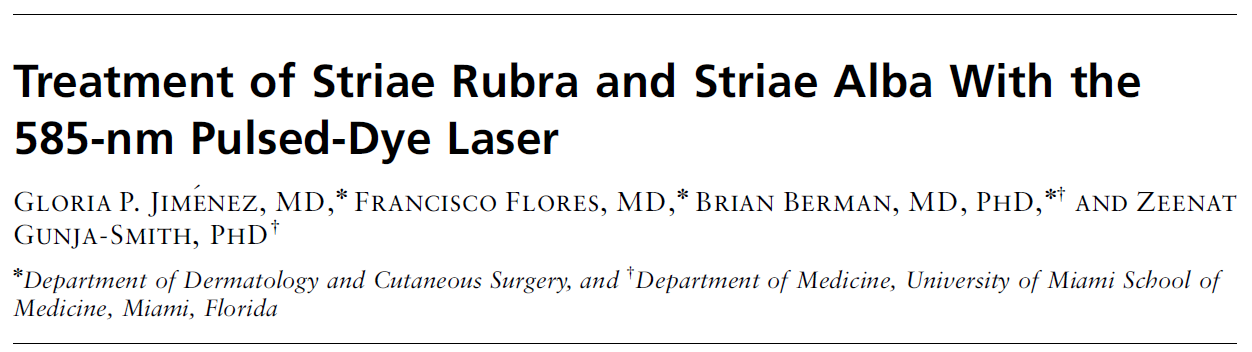
The data above come from a paper published in the American journal of dermatologic surgery. Compared with the group that did not receive PDL treatment (dark gray), the treated group (light gray) showed a reduction in the total area of stretch marks and an increase in the amount of collagen.
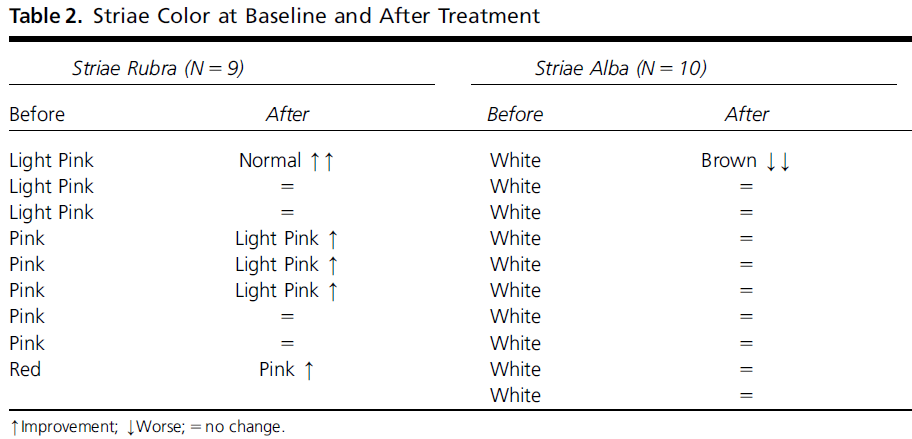
As expected, the change in color was more pronounced in red stretch marks. Fractional lasers and radiofrequency lasers also help, as they too promote collagen synthesis.
White stretch marks are treated along the lines of scar treatment
If the stretch marks have already set into white marks, I change the approach slightly. Ingredients that induce collagen synthesis, such as PDRN, PLLA and PDLA, are helpful, and for areas that have turned white due to hypopigmentation, an excimer laser that stimulates melanocytes may be used.
Areas where the skin surface is depressed and the texture has changed are treated along the lines of scar treatment with fractional lasers or needle RF. This approach to depressions is similar to what I covered in Why I recommend CureJet first for depressed acne scars and Why microneedle RF comes to mind first when acne, pores and redness overlap, and as for devices, I consider Potenza or CureJet depending on the situation. For white stretch marks too, it is better to use collagen-inducing injectables together.
Rather than fixing the number of sessions, it is better not to miss the timing
Honestly, it is difficult to remove stretch marks and scars 100 percent. Because depth and area differ from person to person, there is no formula like "it gets better after so many sessions." In general, white stretch marks are reported to respond much more slowly to treatment than red stretch marks and to require more sessions.
So there is one point I emphasize repeatedly in consultations: rather than trying to fix the number of sessions in advance, do not miss the period when redness still remains. That, in the end, helps reduce the number of treatments needed. If you are unsure which stage your stretch marks are at now, you can start by setting the direction through Consult via chat now with a photo.
References
- Kang, Sewon. Fitzpatrick's Dermatology. 2019.
- Ud-Din, S., D. McGeorge, and A. Bayat. "Topical management of striae distensae (stretch marks): prevention and therapy of striae rubrae and albae." Journal of the European Academy of Dermatology and Venereology 30.2 (2016): 211-222.
- Jiménez, Gloria P., et al. "Treatment of striae rubra and striae alba with the 585-nm pulsed-dye laser." Dermatologic Surgery 29.4 (2003): 362-365.
Author: Dr. Cho Mingyeol, Medical Director (board-certified dermatologist; Master Certification in Pigmentation, Acne, Rosacea and Hair from the Korean Dermatologists Association). You can find the full profile on the Medical Team page. First published 2021-08-25 / Last reviewed 2026-07-09
This article is intended for general information only; the appropriate treatment and outcomes may vary depending on each individual's condition.