

Most of you have probably had the experience of redness lingering for a long time where a pimple has settled down. In the clinic, too, I am asked very often, "If I leave this red mark alone, will it go away?" To give you the conclusion first: some marks fade on their own, and some harden into scars if left as they are. Today I would like to talk about the criteria I use to tell the two apart.
How long do red marks last?
Red marks left on the face can last anywhere from 2-3 months to several months. The problem is that it is quite difficult to predict in advance which of these marks will remain as permanent scars. Even in the same location and at a similar size, the course differs from person to person.
That does not mean it is completely unpredictable, however. There is research analyzing the risk of developing acne scars, so we can get a general sense of the conditions under which the likelihood of scarring goes up.
Who is more prone to scarring?


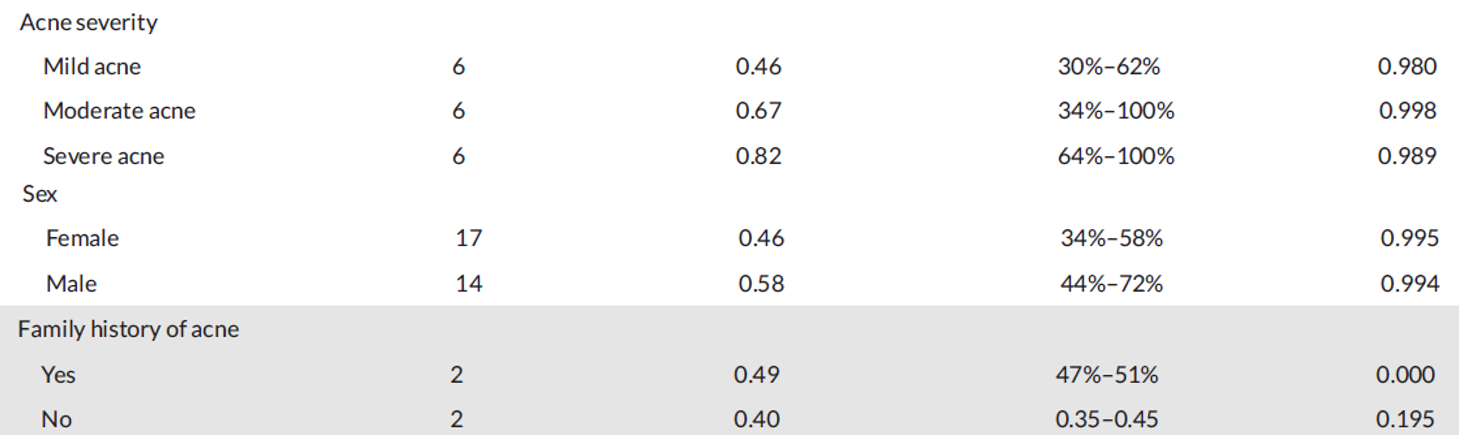
Summarizing the research findings, the conditions reported to carry a relatively higher likelihood of scarring are as follows.
- Being male rather than female
- Having a family history of acne
- The more severe the acne itself
In a way, this may sound obvious. What matters clinically, though, is that if you fall under these conditions, I read it as a signal that the red marks should be watched and managed a little more actively. If you have recurring adult acne, it may also help to refer to Why the sebaceous glands should be examined before the inflammation.
So should every red mark be treated?
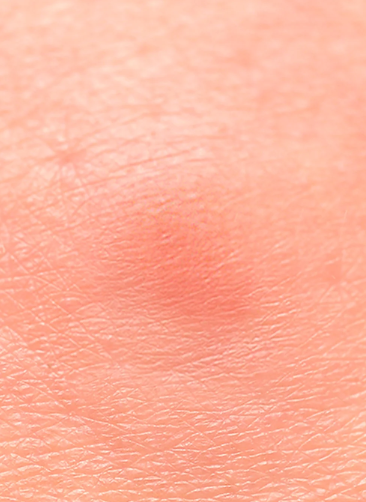
Not necessarily. Red marks can be broadly divided into two groups.
| Category | Features | The direction I recommend |
|---|---|---|
| Marks you can wait on | Areas that have simply turned red with no surface change, after a very small pimple that was not a pus-filled lesion | Observe the course over time, although recovery may be faster with treatment |
| Marks for which I recommend a visit | Areas left red, with the surface sunken or deformed, after squeezing multiple pustular acne lesions on both cheeks | A high chance of progressing to atrophic scars, so a visit is recommended |
Redness without surface change is often resolved to a considerable extent by time. It is true that treatment speeds up recovery, of course, but there is no need to rush.
On the other hand, marks that remain red after squeezing, with the skin surface sunken or its texture changed, are a different story. Because such marks are likely to harden into depressed scars if left alone, I recommend getting them checked early.
Is it only redness that remains, or has the surface changed as well? This single difference is the most practical criterion separating "marks you can wait on" from "marks that need attention."
When you are unsure whether it is a red mark or has already moved on to pigmentation, it is safer to have it checked than to judge on your own. Consult via chat now
At what stage of acne are red marks?
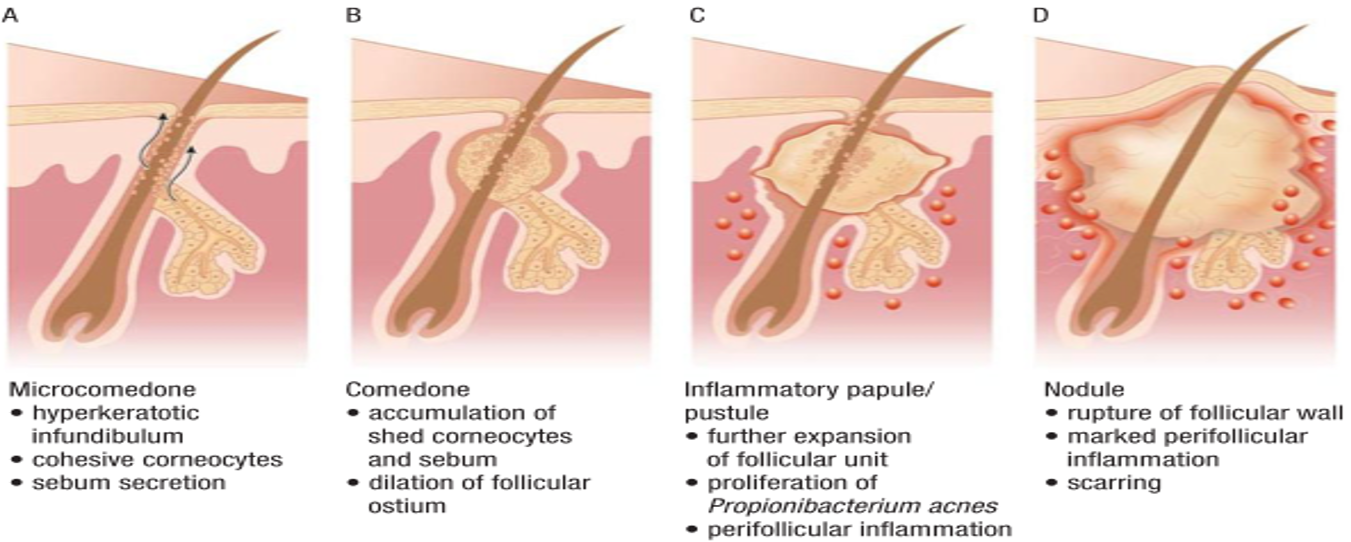
As in the figure above, acne starts from comedones and develops into inflammatory acne. Red marks are the pattern that appears at exactly this inflammatory stage. In other words, a red mark itself is a signal that "this is a spot where inflammation has progressed or is healing."
As yet, there are no specific research findings that clearly distinguish "which red marks" will remain as permanent scars. That is all the more reason why a judgment that looks at both whether the surface has changed and the conditions of scar risk is needed.
How common scars are, according to research
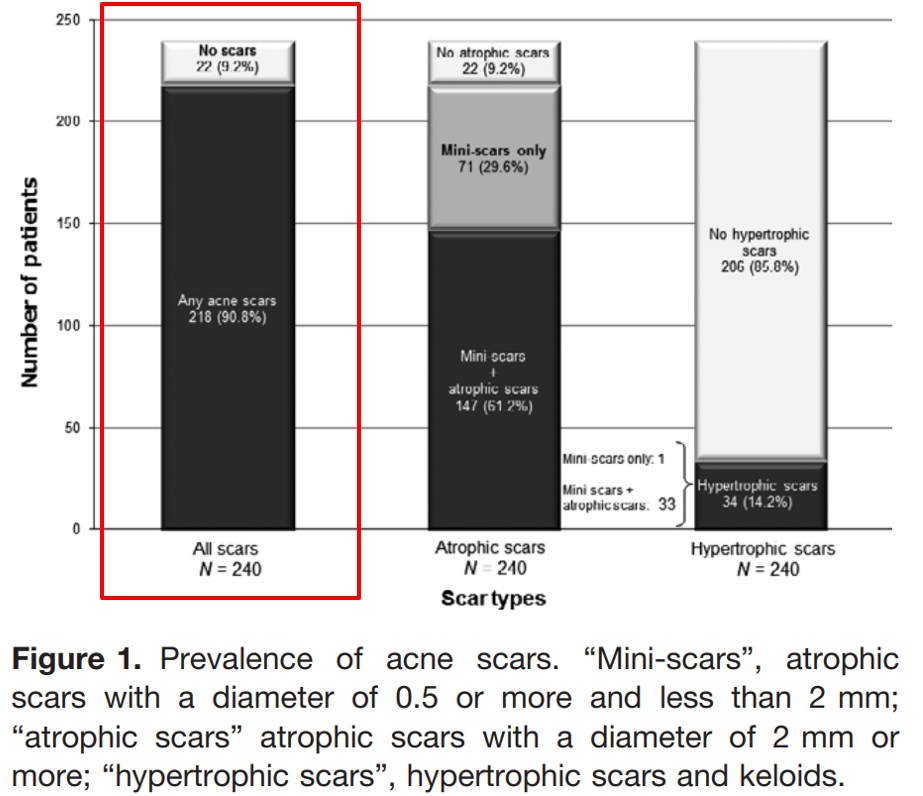
According to a study in Japan that investigated the rate of scarring among acne patients, scars of some form were reported to be observed in a considerable proportion of them. Of course, these are statistics for a group and there are individual differences, but it is clear that traces after acne can remain more commonly than you might think.
So if red marks keep bothering you, or if they come with surface changes, I recommend consulting a dermatologist near you. Pointing out what is hard to judge on your own is the role of the clinic.
How are red marks handled afterward?
In this post, I have focused on the criteria that separate "marks you can wait on" from "marks that need attention." How red marks are actually handled, and how already-depressed scars are approached, are topics that each require detailed explanation, so I have covered them separately.
- If you are curious about the treatment direction for red marks themselves, see How are acne red marks handled?
- If you are concerned about scars that are already depressed, see Why I recommend CureJet first for depressed acne scars
- If the redness has turned into brown pigmentation, see Early care for post-inflammatory hyperpigmentation
The direction differs depending on the nature of the mark, as with V-Beam Perfecta, which I use when vascular redness is prominent. If you would like to first check which side your marks are closer to, please feel free to contact us.
Consult via chat[References]
-
Liu, Lin, et al. "Prevalence and risk factors of acne scars in patients with acne vulgaris." Skin Research and Technology 29.6 (2023): e13386.
-
Hayashi, Nobukazu, Yoshiki Miyachi, and Makoto Kawashima. "Prevalence of scars and 'mini-scars', and their impact on quality of life in Japanese patients with acne." The Journal of dermatology 42.7 (2015): 690-696.
Author: Dr. Cho Mingyeol, Medical Director (board-certified dermatologist; Master Certification in Pigmentation, Acne, Rosacea and Hair from the Korean Dermatologists Association). You can find the full profile on the Medical Team page.
First published 2024-02-13 / Last reviewed 2026-07-09
This article is intended for general information only; the appropriate treatment and outcomes may vary depending on each individual's condition.