

When I hear "I've come for laser toning" in the clinic, rather than immediately deciding on a device, I first look at which pigment we are trying to address and at what depth. That is because the single word "toning" actually contains several branches of treatment. Today I would like to go from the textbook background of pigment treatment to why, even within the same toning, each lesion needs to be approached differently.
Where did the pigment treatment described in textbooks start?
The continuing medical education (CME) articles of the American Academy of Dermatology (AAD), which dermatologists often refer to, introduce fractional laser resurfacing, IPL, and others as laser treatments that can be applied to melasma.
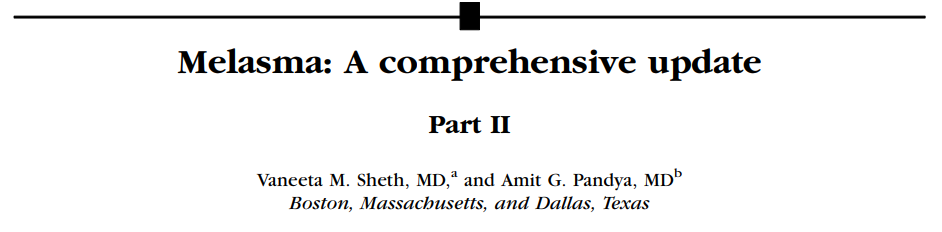
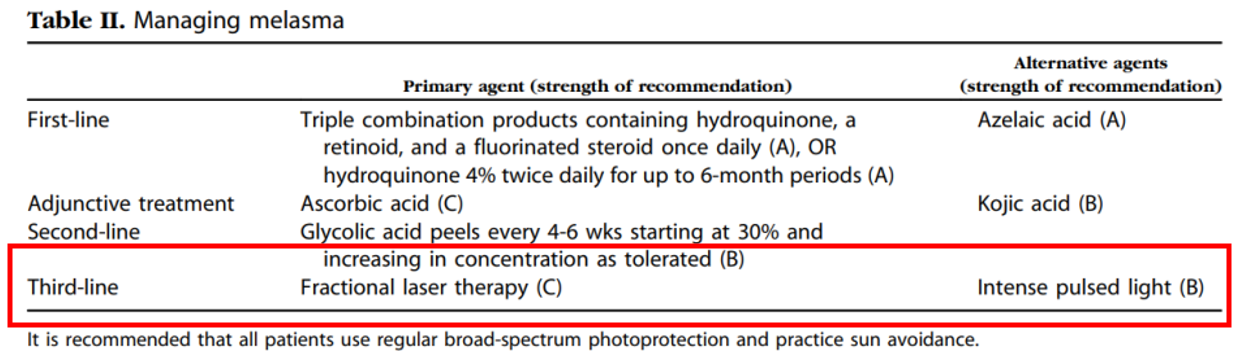
In the past, we too performed many treatments like these, which form crusts at high energy levels. However, most of these methods were developed for Western skin, and for East Asians, whose skin is darker than that of Westerners, they came with the burden of side effects and recovery time. So East Asian skin needed a different kind of approach.
IPL, once regarded as an all-rounder, and the direction that followed
At one time, IPL was regarded as an all-rounder that responded to pigment, blood vessels, and elasticity alike. However, some reactions that were difficult to manage were also reported.
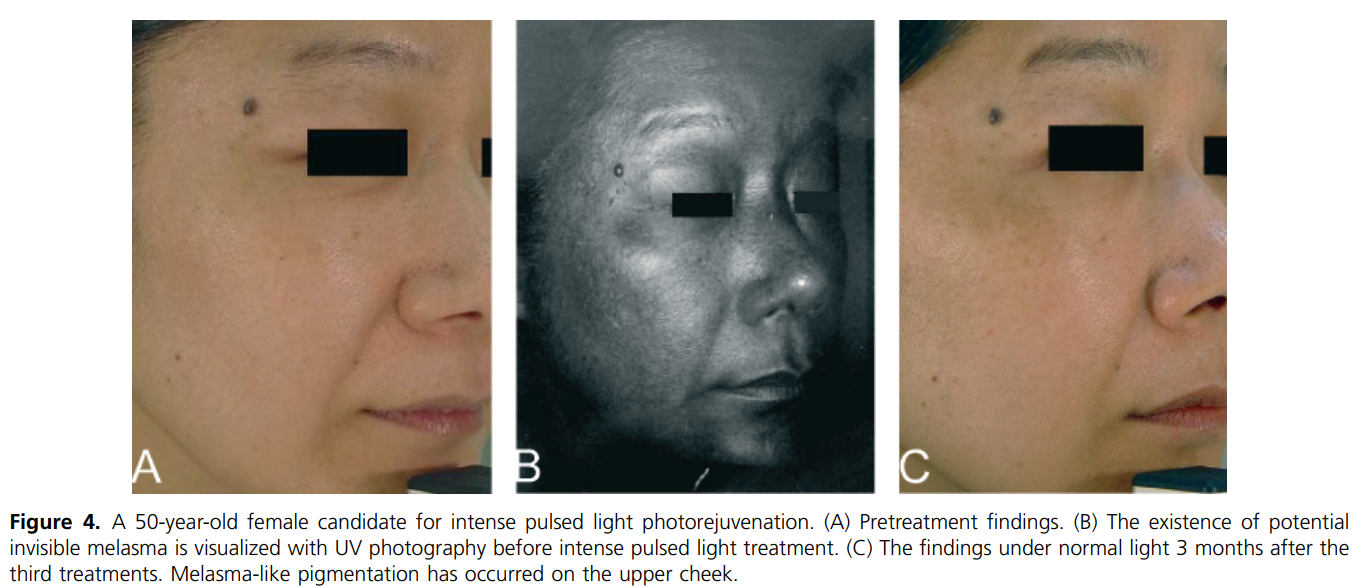
Against this backdrop, in Korea the so-called toning method took hold: treating over multiple sessions at lowered intensity (fluence) with a 1064 nm laser, a wavelength with relatively low melanin absorption that can penetrate more deeply. I have covered in a little more detail how pigment treatment branches off at the diagnosis stage in my post on how dermatologists assess pigment.
Is toning really a single method?
The word may be just "toning," but in reality it does not boil down to one or two methods. Depending on the pigmented lesion, the treatment branches like this.
- Cases that reach a satisfactory result with one or two crust-forming treatments
- Cases that require many repeated sessions at low energy
- Cases that require repeated treatment at high energy
What is more, different pigmented lesions can appear mixed together even in the same patient. This creates the difficulty of having to treat each lesion differently even within one face. There are cases in which pigment comes back when only the epidermal pigment is addressed; the background continues in my post on why melasma comes back even after epidermal melanin is cleared.
Why does diagnosis come before treatment?
Pigmented lesions must be judged by putting together their time of onset, their pattern, and the depth at which the pigment sits. That means diagnosis itself is not simple.
Laser toning is a treatment that requires an accurate understanding of the pigmented lesion first. Rather than going to a place that repeats the same settings in a one-size-fits-all way, finding a dermatologist who has experienced and treated a variety of pigmentary disorders is the way to reduce unnecessary spending and trial and error.
In consultations, I often hear people say that they received pico toning in the past but did not feel much change. Many people also regard pico toning as the most advanced laser treatment. There is something worth pointing out here. I have written in detail about why I do not finish stubborn melasma with a single device in my post on why I don't stop at pico toning alone.
If there is a lesion you are curious about, feel free to ask through consult via chat now.
Pico or nano: which is superior?
For lesions such as hyperpigmentation, melasma, and café-au-lait macules, nanosecond (Q-switched) lasers are still a basic treatment option. Depending on the situation, there are quite a few cases in which a nanosecond laser shows better results.
On the other hand, when dermal pigment must be addressed, as in tattoo removal, nevus of Ota, or ABNOM, a picosecond laser, with its shorter pulse duration and stronger peak power, sometimes shows better results with relatively fewer side effects.
| Category | Nanosecond laser | Picosecond laser |
|---|---|---|
| Main targets | Mainly epidermal hyperpigmentation, melasma, café-au-lait macules | Dermal pigment, tattoos, nevus of Ota, ABNOM |
| Pulse duration | Relatively long | Shorter |
| Peak power | Relatively low | Stronger |
| Position | Used as a basic option | Strength in dermal pigment |
To sum up, picosecond and nanosecond lasers are complementary; neither one always holds the superior position.
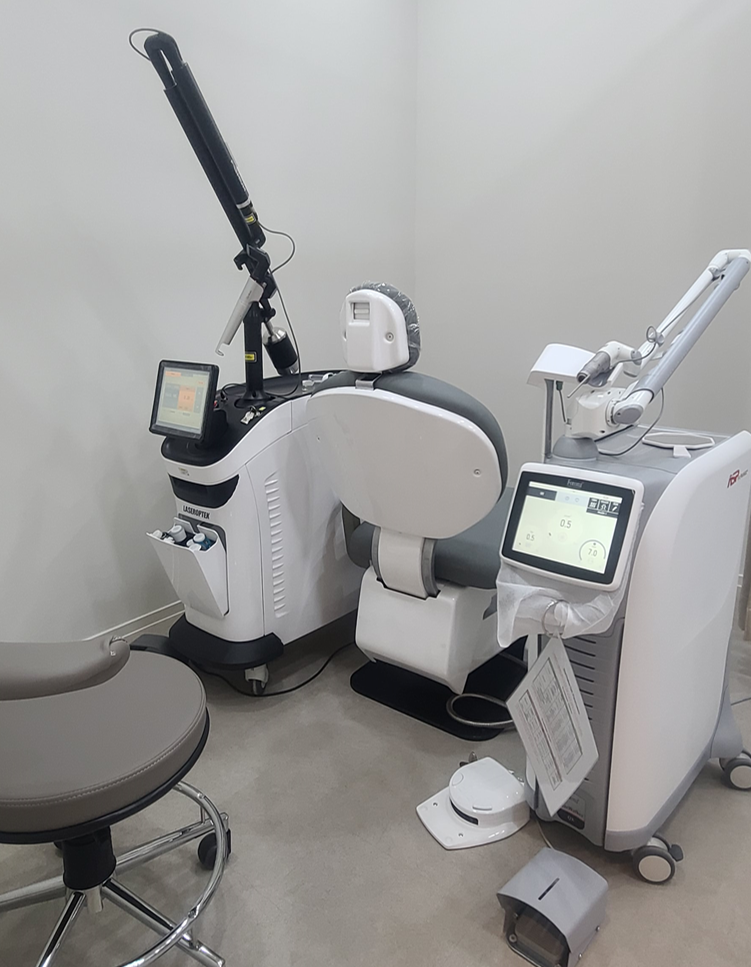
If there was no change even after treatment
When people do not feel any improvement despite receiving the same pigment treatment, there are many cases in which they were treated only at a very low intensity, low enough not to cause side effects. The question of intensity is also a question of diagnosis and planning. For this reason, I recommend seeing a dermatologist near you and receiving treatment suited to your lesion. You can see how we regained control in a case where the color actually darkened with each laser session in A record of getting melasma that darkened with repeated lasers back under control.
If it is difficult to judge which type your pigment is closer to, please contact us first via Consult via chat. We will let you know the cost through a consultation after checking the lesion and the plan.
References
- Sheth, Vaneeta M., and Amit G. Pandya. "Melasma: a comprehensive update: part II." Journal of the American Academy of Dermatology 65.4 (2011): 699-714.
- Gupta, Vishal, and Vinod Kumar Sharma. "Skin typing: Fitzpatrick grading and others." Clinics in dermatology 37.5 (2019): 430-436.
- Chandrashekar, B. S., Chaithra Shenoy, and C. Madura. "Complications of laser and light-based devices therapy in patients with skin of color." Indian Journal of Dermatology, Venereology and Leprology 85 (2019): 24.
- Negishi, Kei, et al. "Study of the incidence and nature of very subtle epidermal melasma in relation to intense pulsed light treatment." Dermatologic surgery 30.6 (2004): 881-886.
Author: Dr. Cho Mingyeol, Medical Director (board-certified dermatologist; Master Certification in Pigmentation, Acne, Rosacea and Hair from the Korean Dermatologists Association). You can find the full profile on the Medical Team page. First published 2024-02-05 / Last reviewed 2026-07-09
This article is intended for general information only; the appropriate treatment and outcomes may vary depending on each individual's condition.