

There is a question I hear much more often in the clinic once summer arrives: "I heard it's better not to do pigment treatment in summer. Is it okay to have it now?" To give you the conclusion first, there is no need to lump all pigment treatment together under the single season of summer and put it off. However, summer safety clearly differs depending on the wavelength and method of the laser. That is why I look at the wavelength and method before the timing.
Is it okay to just leave pigmentation alone in summer?
If you leave pigmentation that has already appeared untouched because strong UV feels burdensome, it tends to drift toward becoming even darker. What is considered relatively low-burden even in summer is the low-fluence Q-switched Nd:YAG laser, commonly called toning treatment.
One thing to point out is that not every treatment that uses the same name is the same treatment. Just as omakase does not bring the same menu at every restaurant, toning also differs in character depending on the device, parameters and diagnosis. What to check when choosing toning is summarized in more detail in What is good to know before getting laser toning.
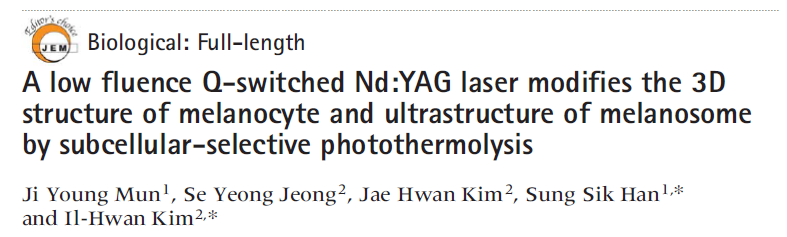
Why 1064 nm toning is considered even in summer
The 1064 nm wavelength used by the Q-switched Nd:YAG laser has relatively low absorption in the epidermis. Because it does not leave significant damage on the epidermis, the procedure can be continued with relatively little burden even in summer when UV is strong.
You can compare it to pruning a tree's branches in summer so that its leaves cannot grow thick and spread.
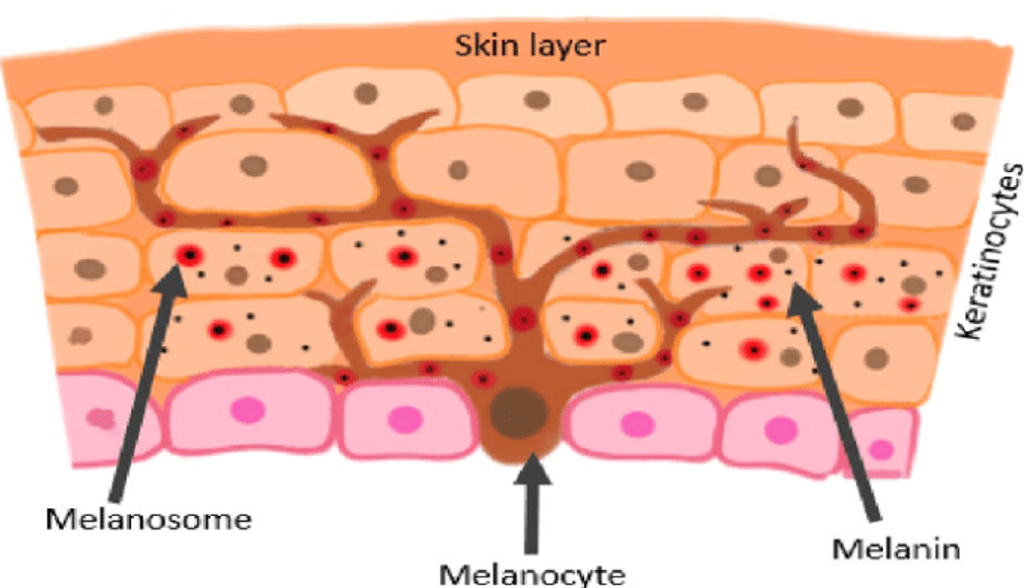
The representative role of this treatment is to cut the dendrites of the melanocytes in the epidermis, blocking the flow by which pigment spreads to surrounding areas and deposition deepens.
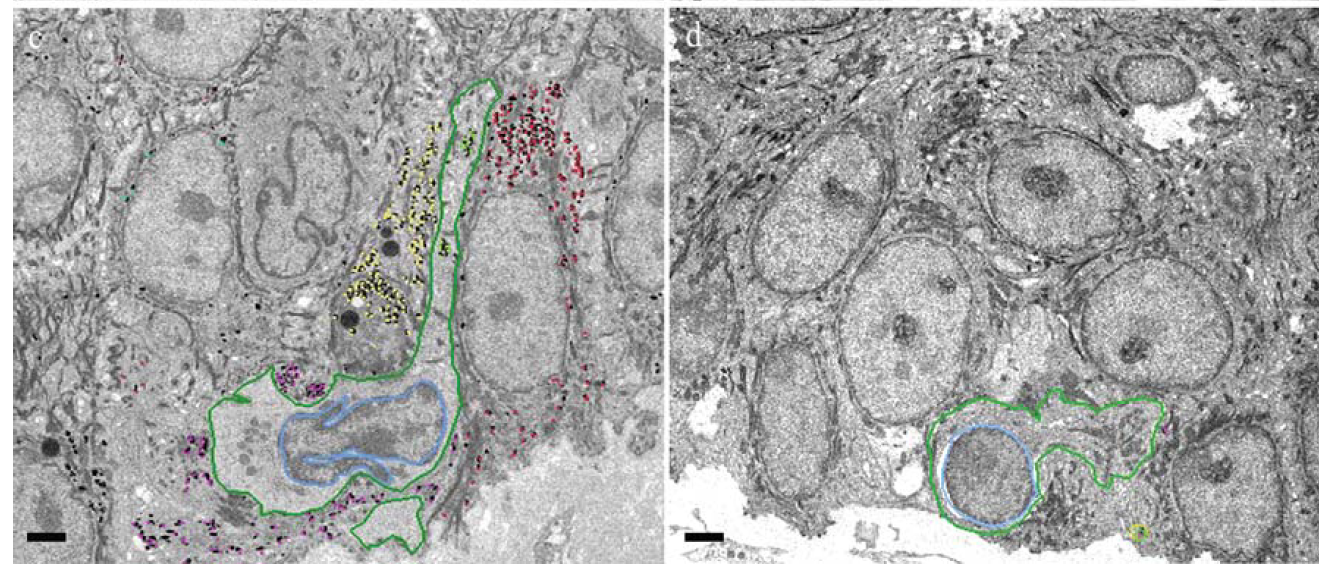
Observed under an electron microscope, as in the photo above, it affects the structure of the melanocytes and even the ultrastructure of the melanosomes, suppressing the transfer of melanin and reducing epidermal melanosomes. As a result, it works toward overall brightening while also lowering the likelihood of pigment deposition. Why clearing only epidermal pigment is not enough and why the dermal background must also be considered is explained further in Why pigment comes back even after clearing only epidermal melanin.
If you spend a lot of time outdoors in summer, continuing low-fluence toning on a regular schedule helps in managing the color.
Why ablative lasers depend more on the season
On the other hand, there are treatments for which the season of summer should be weighed more carefully. CO2 lasers and Erbium:YAG lasers are ablative lasers that shave off or burn the skin. They are used to treat lesions such as flat warts and seborrheic keratoses, but if UV exposure increases after the procedure, the likelihood of post-inflammatory hyperpigmentation, or PIH, goes up.
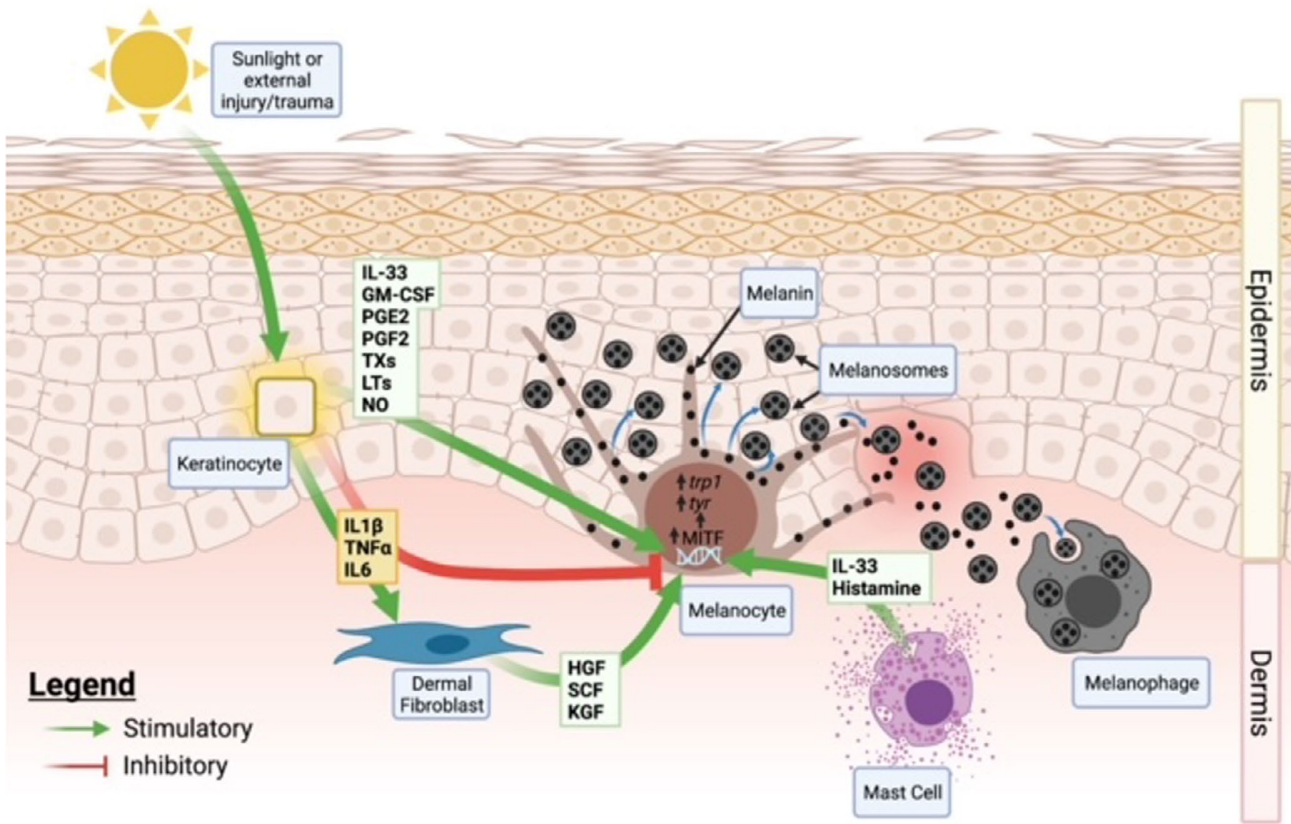
There is another practical issue as well. After such procedures, a hydrocolloid dressing such as DuoDERM is essential, but in summer, with a lot of sweat and heat, it is not easy to keep the dressing stable. Long-pulsed 532 nm lasers such as IPL or Excel V do not shave off the skin, but they can create fine crusts on the epidermis, so the risk of PIH may also rise during periods of heavy UV exposure.
How the treatment method and seasonal considerations differ by lesion can be summarized as follows.
| Method | Typical situation | Summer considerations |
|---|---|---|
| Low-fluence toning 1064 nm | Overall pigment management | Little epidermal damage, so the burden is relatively low |
| Ablative CO2 Erbium-YAG | Flat warts, seborrheic keratosis, milia | Higher likelihood of PIH with UV exposure |
| Long pulsed 532 nm | Superficial pigmented lesions | Fine crusts also raise the risk of PIH |
So for people who spend a lot of time outdoors in summer, it is not a bad choice to push back procedures that remove flat warts, seborrheic keratoses or milia with CO2 or Erbium:YAG, or scar treatment using CO2 fractional laser, and plan them for autumn. If you are planning an ablative laser in summer, it helps to understand in advance the characteristics of devices such as the Reepot Laser, looking at recovery care as well.
There are also many cases where it is confusing whether something is seborrheic keratosis, lentigo or another pigmentary condition. I have separately gone over the criteria for distinguishing lesions in Pigmentary conditions easily confused with seborrheic keratosis, so please refer to it.
- Low-fluence toning places little burden on the epidermis, so it tends to be considered even in summer
- With ablative lasers, the key issues are UV exposure after the procedure and keeping the dressing in place
- Whether to adjust the timing depends on the type of lesion
If you are weighing when to have pigment treatment in summer, it is best to first set a direction that fits your lesion and lifestyle. Start a chat consultation now
Revisiting the common belief that the season decides the result
It is hard to say definitively that always postponing is the right answer. Let us look at the following data together.

There is a report that PIH was observed in about 20.3% of patients treated with a 532 nm Q-switched laser, but no seasonal effect was found.
These data suggest that the season of summer itself is not the only variable that determines PIH. In other words, with appropriate care alongside treatment, pigment deposition can be adequately prevented even in summer. How the course diverges depending on early care when PIH actually occurs is written up in detail in Post-inflammatory hyperpigmentation that I often see in the clinic.
How I manage pigment treatment in summer
If you diligently apply sunscreen after the procedure and faithfully follow basic care, you can continue laser procedures in summer in a way that suits the method. Even if PIH does occur, it often improves with appropriate care and additional treatment, so I do not think you need to worry excessively. However, the appropriate treatment and course may differ depending on each individual's skin type, lesion and lifestyle.
To sum up, rather than leaving pigmentation alone just because it is summer, it is more reasonable to use wavelength and method as the criteria to separate the care you can do now from the procedures to postpone. Low-fluence toning continues with Q-switched devices such as StarWalker, and ablative treatments are moved to a time when recovery care is easier. If it is unclear what kind of lesion you have, you may want to read What to check when you can't tell seborrheic keratosis from lentigo first.
If you are wondering whether your pigmentation is the kind that can be managed now or a lesion better postponed until autumn, please feel free to ask. Consult via chat
Author: Dr. Cho Mingyeol, Medical Director (board-certified dermatologist; Master Certification in Pigmentation, Acne, Rosacea and Hair from the Korean Dermatologists Association). You can find the full profile on the Medical Team page. First published 2024-06-10 / Last reviewed 2026-07-09
This article is intended for general information only; the appropriate treatment and outcomes may vary depending on each individual's condition.