

People who come in because the center of their face often turns red frequently ask me, "Why does this have to happen to me?" The redness of rosacea is not the result of laziness or poor skincare; it appears when the inherent nature of your skin overlaps with stimuli in daily life. Let me organize the structure of its causes along two axes: genetics and triggers.
The cause cannot yet be summed up in one line
To be honest, the cause of rosacea has not yet been clearly identified as a single factor.

That does not mean we know nothing. As with many skin conditions, several factors are intertwined in a complex way in the development of rosacea. The figure below gives you the whole picture at a glance.
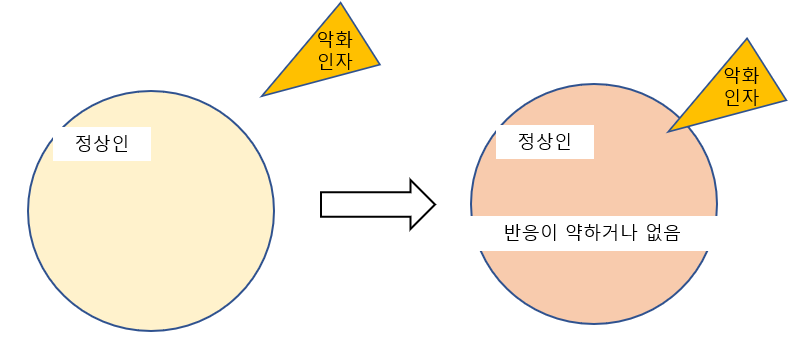
In people without facial flushing, the face does not turn noticeably red even with fairly strong stimuli.
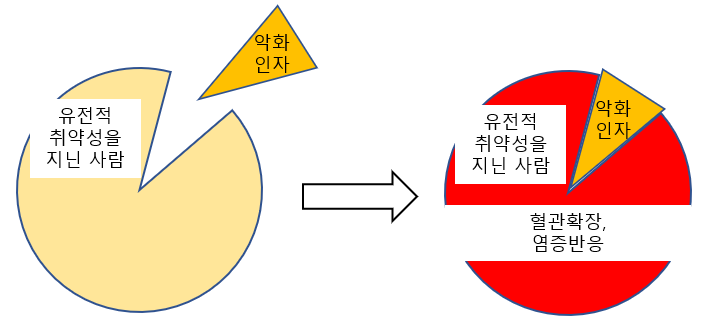
In contrast, in people with a genetic vulnerability, certain stimuli strongly provoke immune and neurovascular responses, and symptoms appear. In the end, you can understand the redness as beginning where inborn predisposition meets external stimuli. Now let us look at the two axes one at a time.
How much does inborn vulnerability explain?
According to academic society materials and research, a family history is reported in a considerable proportion of rosacea patients. This is the basis for suspecting a genetic link, although there are individual differences.

The photo above shows the faces of King Charles III of the British royal family and his two sons, William and Harry. Like their father, the central parts of their faces look red. It is a familiar example of how facial flushing tends to run in families.
The problem is that this is an area we cannot change at will.

The inborn vulnerability itself cannot be removed. So in the clinic, the goal is not to fix your constitution but to pull the trigger less often. Distinguishing between what can and cannot be changed is the starting point of treatment.
What happens inside the body when the trigger is pulled?
Most people have no particular reaction to pollen, but some react to it with allergic rhinitis. Rosacea is similar. The same stimulus leads to a far more intense reaction in people who have a vulnerability.
Representative aggravating factors are as follows.
- UV exposure
- Irritating foods
- Psychological stress
- Strenuous exercise
- High temperatures, saunas and intense heat
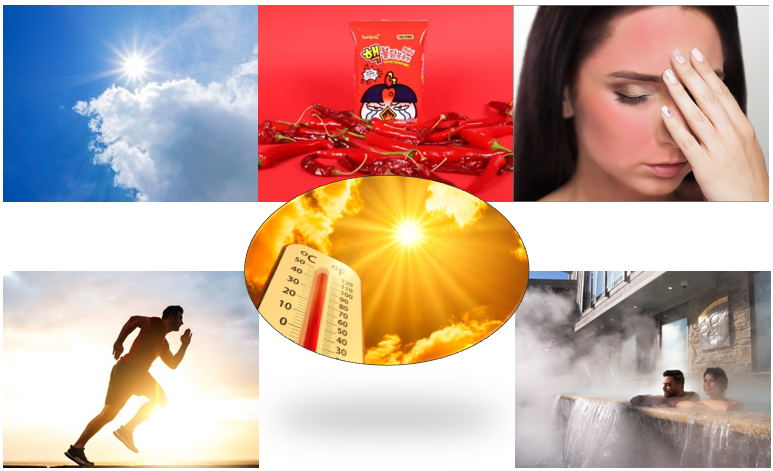
Imagine a day when you are under a lot of stress, exercise hard outdoors in the blazing midday sun, eat spicy stir-fried noodles and then go to a sauna. Because it gathers all the aggravating factors in one place, the redness is likely to get worse. The process by which these stimuli actually produce symptoms is summarized in the figure below.
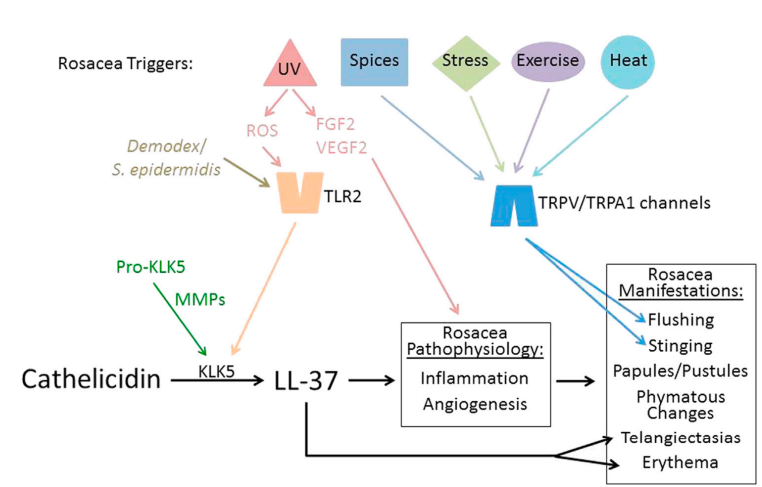
The key factor here is the antimicrobial peptide. When this substance, called LL-37, is overexpressed, unnecessary inflammatory and vascular responses follow one after another, and as a result the redness and heat typical of rosacea appear. That is why I can say that avoiding the aggravating factors listed above is the very beginning of treatment.
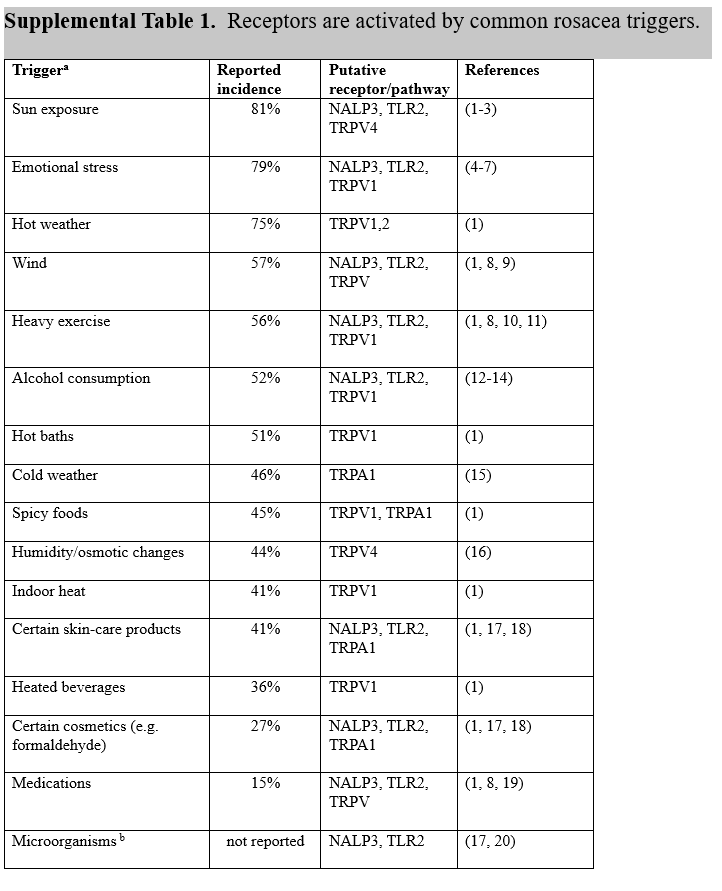
Aggravating factors in a table
I have briefly grouped the triggers you encounter in daily life with the corresponding ways to respond.
| Aggravating factor | Everyday example | Direction of response |
|---|---|---|
| UV | Outdoor activity at midday | Use sunscreen and shade |
| Irritating foods | Spicy and hot food, drinking | Adjust the intensity of stimuli |
| Psychological stress | Overwork, lack of sleep | Prioritize recovery and rest |
| Strenuous exercise | Heat right after high-intensity exercise | Spread out intensity and duration |
| High temperature | Sauna, hot bath | Keep temperatures lukewarm |
The topic of food is a little different in nature, so I have explained it in detail in a separate post on rosacea and food. If you are unsure what your own triggers are, you can go over your lifestyle habits with me through Start a chat consultation now.
The paradox of topical steroids as a cause
Surprisingly, topical steroids are also one of the major causes of rosacea.

As I mentioned in the earlier Part 1 on symptoms, rosacea is not easy to diagnose in its early stage.
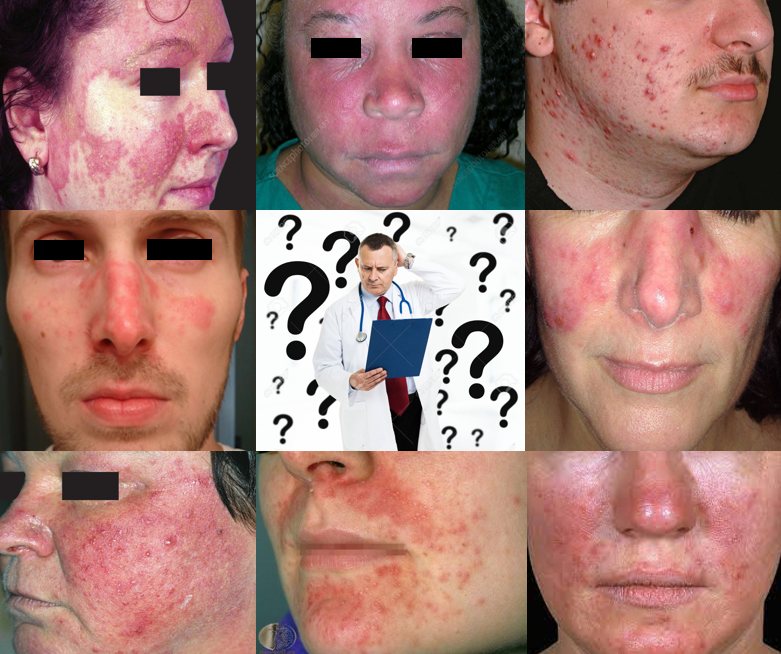
So it is not uncommon for it to be mistaken for seborrheic dermatitis or contact dermatitis and for a topical steroid to be prescribed and applied. At first it seems to calm down, but if you keep moving from clinic to clinic and repeating steroids every time it recurs, the rosacea can actually get worse. Of course, the two conditions often overlap, and steroids are sometimes used for a short period when needed. The key is judgment that fits the situation.
Why I recommend being seen consistently at one place
To summarize:
- Since an inborn vulnerability cannot be changed, care starts with reducing triggers.
- Identify aggravating factors such as UV, heat, irritating foods and stress, and reduce them one by one.
- Rather than repeating steroids based on self-judgment, get an accurate diagnosis first.
For these reasons, rather than going from one clinic to another, I recommend choosing one place where a board-certified dermatologist sees you and following your progress there. The more the redness alternates between getting better and worse, the more helpful it is for diagnosis and setting a direction to have one set of eyes that knows its course. If you are curious about how to approach cosmetics, the post on what to take away in rosacea is also worth reading.
If the redness has been recurring for a long time and it is hard to find a direction, please feel free to leave an inquiry below.
Consult via chatAcademic sources referenced
The content of this post is based on the following literature.
- Wolff, Klaus, et al. Fitzpatrick's Color Atlas, Dermatology. 2012.
- Chang, Anne Lynn S., et al. Assessment of the genetic basis of rosacea by genome-wide association study. Journal of Investigative Dermatology, 2015.
- Two, Aimee M., et al. Rosacea part I. Introduction, categorization, histology, pathogenesis, and risk factors. Journal of the American Academy of Dermatology, 2015.
- Holmes, Anna D., and Martin Steinhoff. Integrative concepts of rosacea pathophysiology, clinical presentation and new therapeutics. Experimental Dermatology, 2017.
Author: Dr. Cho Mingyeol, Medical Director (board-certified dermatologist; Master Certification in Pigmentation, Acne, Rosacea and Hair from the Korean Dermatologists Association). You can find the full profile on the Medical Team page. First published 2023-02-27 / Last reviewed 2026-07-09
This article is intended for general information only; the appropriate treatment and outcomes may vary depending on each individual's condition.