

On a glaring sunny day, raising your hand to block the light pouring onto your face is an almost reflexive gesture. But when I consult on pigmentation or blemishes on the back of the hand in the clinic, I always find myself turning the same question back to the patient: "When you shade yourself from the sun, do you turn the back of your hand up, or your palm?" Most people turn the back of the hand up. Today I would like to explain why I recommend changing that habit, following the structure of the skin and the principles by which pigment forms.

Why is the back of the hand damaged so easily?
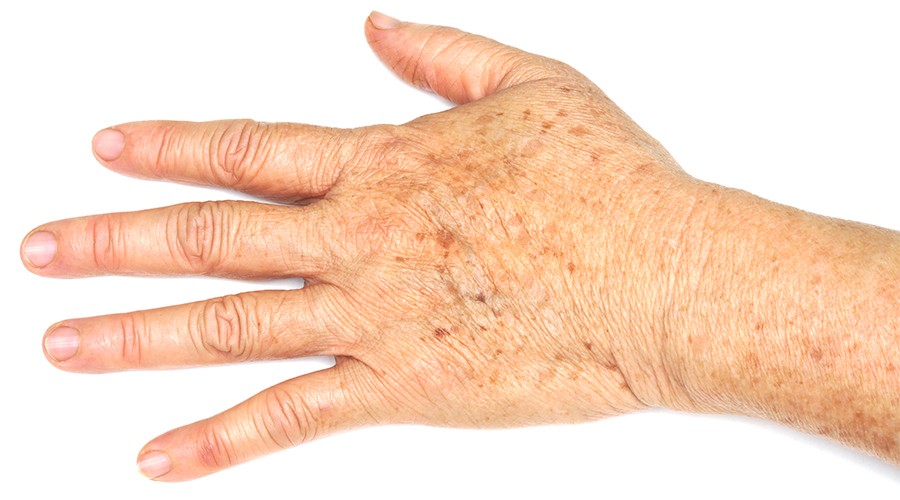
The skin on the back of the hand is thinner and more sensitive than that of the palm. It is correspondingly vulnerable to ultraviolet (UV) light, and repeated exposure leaves various traces. The changes I check for when examining the back of the hand in the clinic can generally be summarized as follows.
- A state in which pigmented lesions such as hyperpigmentation, lentigines and blemishes form easily
- A trend in which the skin on the back of the hand gradually thins due to UV-induced skin atrophy
- An aged appearance in which blood vessels and tendons stand out through the thinned skin
As a result, aging of the back of the hand progresses, as in the photo below.
How do the palm and the back of the hand differ?
On the other hand, the skin of the palm is thick and tough, so it withstands external stimuli better. Because the stratum corneum itself is thicker than on the back of the hand, it is physically better equipped to block UV light. Comparing the two areas at a glance:
| Category | Back of the hand | Palm |
|---|---|---|
| Skin thickness | Thin | Thick |
| Stratum corneum | Thin | Thick |
| UV vulnerability | High | Low |
| Melanocyte density | Relatively high | Low |
| Pigmented lesions | Form easily | Rare |
The fact that the back of the hand and the palm look different in color also ultimately stems from differences in melanocytes and the amount of UV exposure. The palms and soles are areas with a low density of melanocytes, where less melanin is produced.
In fact, even in people with darker skin, the palms remain relatively light, and the color difference in this area is known to be small even across ethnicities.

DKK1, the coordinator
Dickkopf-1 (DKK1) is pointed to as one of the reasons less pigment forms on the palms and soles. DKK1 is a signaling substance secreted by fibroblasts in the dermis and is found mainly in the skin of the palms and soles.
This factor works by inhibiting the MITF and beta-catenin pathways. As a result, melanin production decreases while skin thickness increases. The characteristics of palm skin, both lighter in color and thicker, can be explained to a considerable extent by this single regulatory axis.
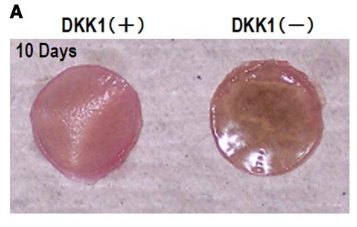
In the photo above, you can see that the skin on the left, cultured with DKK1 treatment, is relatively thicker and has less pigment. This is where the cellular-level evidence for why the palm makes a better shield against UV light becomes clear.
The fact that pigment is regulated at multiple levels like this is an important premise in the clinic as well. If you approach it by looking only at the surface color, much of the pigment comes back, and I have covered this in more detail in why melasma comes back even after clearing epidermal melanin. When you are unsure whether a brown spot on the back of your hand is a simple blemish or another pigmentary condition, three pigmentary conditions easily confused with seborrheic keratosis may also help.
If pigment has already settled on the back of your hand, it is better to have your condition checked first rather than judging it yourself. Consult via chat now
So, shade with your palm
To sum up: shading the sun with your palm rather than the back of your hand is more effective at protecting the skin from UV light, and it also helps protect the thin, sensitive skin on the back of the hand. It does not require much cost or effort. All you have to do is flip your hand over.
From now on, instead of shading the sun with the back of your hand, try shading it with your palm.

If pigment has already formed on the back of your hand
Of course, no matter how well you shade your hand, pigment that is already there will not disappear on its own. The approach to lentigines and hyperpigmentation on the back of the hand differs depending on the depth and type of the lesion, and I have summarized the criteria for that judgment in post-inflammatory hyperpigmentation, which I often see in the clinic and I've heard it's better not to treat pigmentation in summer. If you are curious about the current condition of the back of your hand, please use Consult via chat and send us a photo. Depending on your condition, we will explain the necessary care direction and costs after the consultation.
[References]
-
Thingnes, Josef, et al. "Understanding the melanocyte distribution in human epidermis: an agent-based computational model approach." PloS one 7.7 (2012): e40377.
-
Yamaguchi, Yuji, et al. "Dickkopf 1 (DKK1) regulates skin pigmentation and thickness by affecting Wnt/β‐catenin signaling in keratinocytes." The FASEB Journal 22.4 (2008): 1009-1020.
Author: Dr. Cho Mingyeol, Medical Director (board-certified dermatologist; Master Certification in Pigmentation, Acne, Rosacea and Hair from the Korean Dermatologists Association). You can find the full profile on the Medical Team page. First published 2024-05-17 / Last reviewed 2026-07-09
This article is intended for general information only; the appropriate treatment and outcomes may vary depending on each individual's condition.