

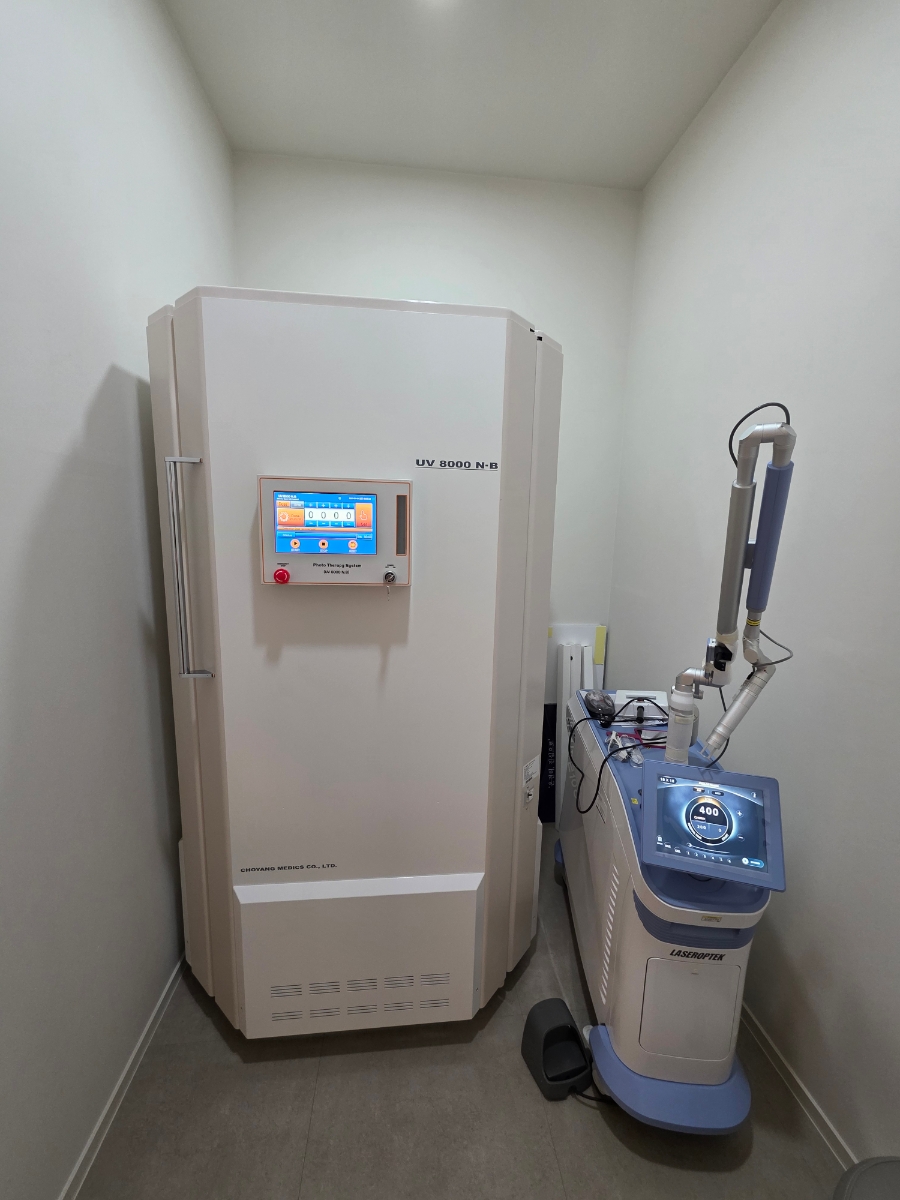
When I see conditions with a long course such as vitiligo and psoriasis in the clinic, there is always a gap that medication and whole-body phototherapy alone cannot fill. These are lesions like a spot on the back of the hand, a corner of the scalp, or the knees, which bother the person every day even if they are hidden by clothing. Adding the Palas Premium 308-nanometer excimer laser to our practice this time was precisely to target that remaining gap.
Why was whole-body phototherapy alone not quite enough
Whole-body phototherapy using a conventional UV phototherapy device has the clear advantage of being able to treat a wide area at once. However, when lesions are limited to just a few places, the fact that healthy skin also gets exposed to the light always concerned me. The desire to treat only the lesions while reducing unnecessary stimulation of normal skin was the starting point for considering a localized irradiation device.
What is different about the 308 nm excimer
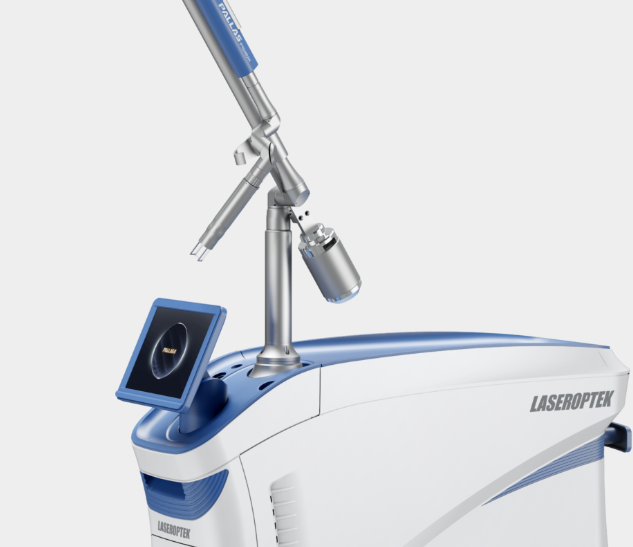
The Palas Premium is an excimer laser that delivers UVB light at a wavelength of 308 nanometers. This 308 nm band is known as a wavelength that is especially useful in treating vitiligo and psoriasis. The key lies in the method of irradiation.
- Aims light precisely at the lesion only, minimizing stimulation of normal skin
- Selectively approaches only the areas that need treatment
- The procedure is short, so it tends not to interfere much with daily life afterward
- It is nearly painless, so its use can be considered for children and people with sensitive skin
Summarizing the difference between exposing the whole body to light and localized irradiation in a table gives the following.
| Category | Whole-body phototherapy | 308 nm localized irradiation |
|---|---|---|
| Irradiation range | Entire wide body surface | Selected lesion areas |
| Stimulation of normal skin | Exposed together | Aims to minimize |
| Good fit | When lesions are widespread | Localized lesions such as on the scalp, elbows and knees |
What response can be expected in vitiligo
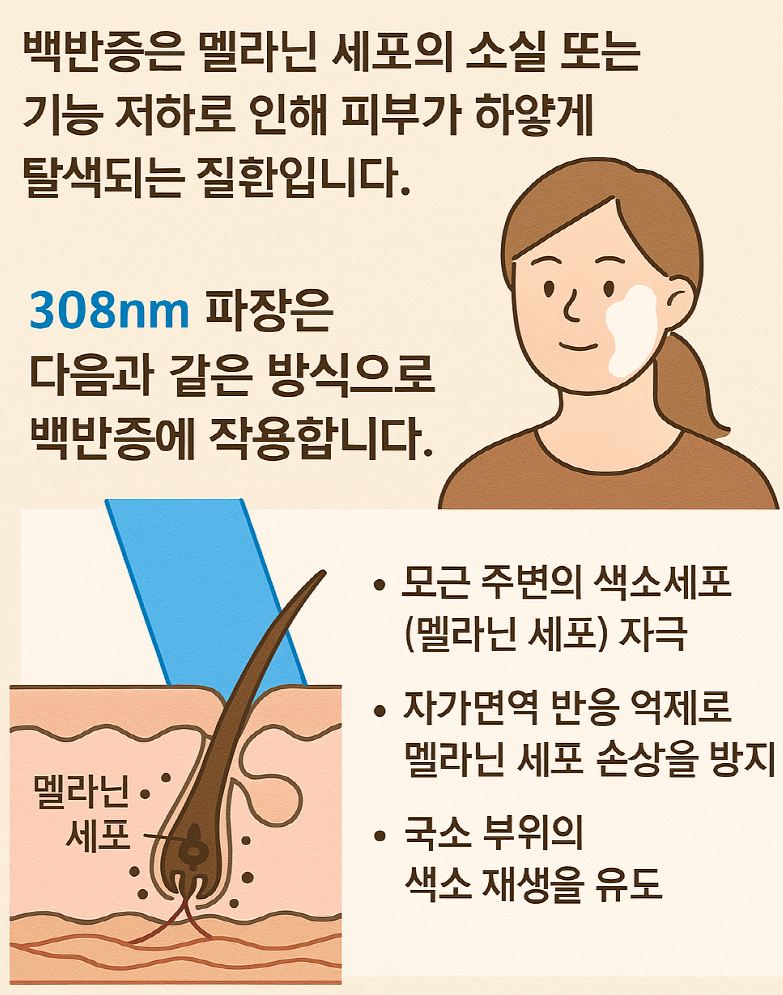
Vitiligo is a condition in which white patches appear as the pigment cells that make melanin disappear. Here, 308 nm irradiation works in the direction of inducing the reactivation of pigment cells and repigmentation.
Clinical studies have reported cases in which repigmentation of around 65-75% was observed in lesions on the face and neck. However, this figure varies widely depending on the location of the lesion, when it began, and the individual's skin condition. Summarizing the pattern I often see in the clinic, the earlier the lesion is after onset, the more relatively quickly and clearly the response tends to appear.
Even with the same vitiligo, it is common for the face to recover well while the tips of the hands and feet respond slowly. That is why I first look at "whether this lesion suits this device," not "this device will improve everything."
Because the nature of the response differs by lesion, we sometimes reach a stage where color does not return as much as hoped with irradiation alone. How I set the direction at this point is covered separately and in detail in Signs to consider grafting when color has not returned after a year of excimer and Criteria for switching to grafting in vitiligo that has stopped responding to laser.
If you are wondering whether your lesion suits this device, or whether your current response has plateaued, you can start by checking your condition through Consult via chat now.
By what principle does psoriasis improve
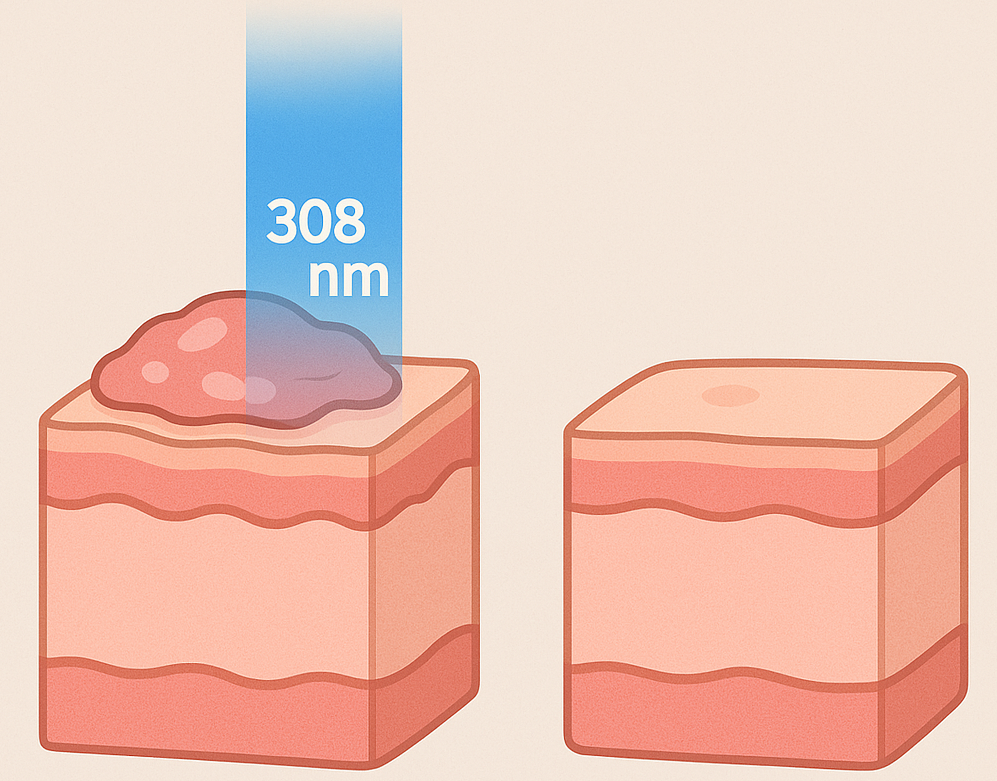
Psoriasis is a chronic skin condition in which skin cells are produced far too quickly due to an abnormal immune response, causing redness, thick scaling and plaque lesions to recur. The 308 nm excimer intervenes in this process in two directions.
First, it acts to calm inflammation by suppressing the overactivated immune response. Second, it slows the growth rate of keratinocytes that had been proliferating too quickly. As a result, we can expect the burden of plaque lesions, where redness and scaling stood out, to lessen.
Why I focus especially on localized lesions
In both psoriasis and vitiligo, there are places that whole-body phototherapy has difficulty reaching. Representative examples are curved areas or lesions that remain locally, such as the scalp, elbows and knees. Being able to selectively aim light at these areas is the advantage of a localized irradiation device. Because it approaches only the areas that need treatment, the burden on normal skin is relatively lighter, and the procedure itself tends to be short.
How does treatment actually proceed
The rough flow I set in the clinic is as follows.
- I check the location, extent and time of onset of the lesion to first judge whether this device suits the situation.
- I adjust the irradiation intensity according to whether it is vitiligo or psoriasis and the individual's skin response.
- Generally, treatment is repeated two to three times a week while the response is monitored.
- Depending on progress, I readjust the irradiation intensity and interval and, if needed, whether to combine it with other treatments.
The treatment interval and intensity are not a fixed formula but a process of fine-tuning based on how the lesion responds at each visit. So the initial plan is strictly a starting point, and the actual plan keeps being refined according to the response.
The longer the condition lasts, the more it matters to have one more tool
Vitiligo and psoriasis follow a chronic course and have a considerable impact on quality of life. With the recent development of various devices and treatments, there is more room than before to expect a better course in terms of symptom relief and suppression of recurrence. I believe the Palas 308 nm excimer laser we have added this time is meaningful in that it secures one more option, especially in situations where localized lesions need to be targeted.

However, no device is equally the answer for every lesion. Whether your current lesion suits this treatment and what kind of course to aim for are best discussed by looking at your condition directly. If it is hard to set a direction for your vitiligo or psoriasis, feel free to reach out with the Consult via chat button. Costs vary depending on the extent of the lesions, so they are explained after the consultation.
Author: Dr. Cho Mingyeol, Medical Director (board-certified dermatologist; Master Certification in Pigmentation, Acne, Rosacea and Hair from the Korean Dermatologists Association). You can find the full profile on the Medical Team page. First published 2025-04-15 / Last reviewed 2026-07-09
This article is intended for general information only; the appropriate treatment and outcomes may vary depending on each individual's condition.